|
Save Our
Cabinets is a Montana based organization, formed to educate the public about the impacts of
the proposed Montanore mine. JOIN NOW: Membership Form
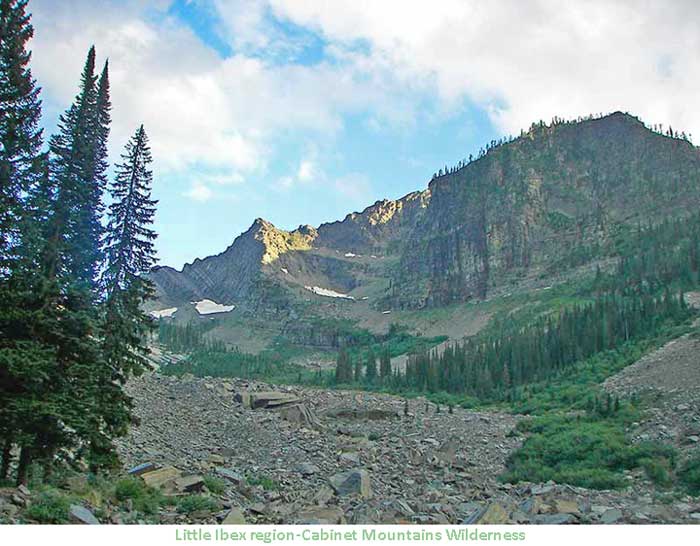
Little Ibex region-Cabinet Mountains Wilderness THE CABINET MOUNTAINS The Cabinet Mountains are located in northwestern Montana. This mountain range is bordered to the west by Idaho’s Selkirk Mountains; to the south are the Bitterroots; to the north are the Purcells; and to the east are the Salish Mountains. The far western portion of the Cabinets are in Idaho’s Panhandle National Forest; the middle section is in the Kootenai National Forest; and the eastern third is located in the Lolo National Forest. The jewel of the region is the 94,360-acre Cabinet Mountains Wilderness Area (CMWA), which is the only federally protected wilderness in the 2.2 million acre Kootenai National Forest. The Cabinet Mountains Wilderness was designated a primitive area in 1935, and was included in the original Wilderness Act of 1964. The geography of this small, 94,360-acre wilderness includes 85 alpine lakes, a temperate rain forest, and a mountainous topography. The highest point in the Cabinets is Snowshoe Peak at 8,738 feet. The Cabinet Mountains Wilderness provides habitat for small populations of grizzly bear, lynx, and wolverine. This isolated wilderness is also home to wolves, mountain goats, elk, bighorn sheep, and an abundant population of mule and white tail deer. The clean, clear waters of the Cabinet Mountains Wilderness provide habitat for the threatened bull trout and a pure strain of westslope cutthroat trout. Protecting this island of habitat from the perpetual impacts of mining and other threats is essential for the preservation of numerous species of wildlife. The Cabinet Mountains Wilderness must remain wild.
Threats to the Cabinet Mountains Wilderness Two massive mining projects are proposed that would allow copper and silver to be extracted from beneath the alpine lakes of the Cabinet Mountains Wilderness. The Rock Creek and Montanore mines are proposing to operate within a mile of each other, compounding operational impacts to the wilderness. 1) Impacts would include the displacement of two threatened species from their habitat, the grizzly bear and lynx. The Montanore and Rock Creek mines would impact approximately 35,000 acres of grizzly bear habitat. Only 10-15 grizzly bears remain in the Cabinet Mountains Wilderness; displacement would have a significant impact on the bear’s survival in the region. 2) Impacts to wildlife would include the displacement of mountain goats, and lost habitat for the region’s small population of wolverine. 3) Mining would significantly degrade and de-water creeks, streams, and lakes, both inside and outside the wilderness. Many of these creeks and streams provide habitat for the threatened bull trout. 4) Mine facilities would be located along the border of this small and narrow wilderness. The noise and visual impacts generated from these projects would not only have dire consequences on the region’s wildlife, but would also make it impossible for visitors to the wilderness to find the solitude they are seeking. For more information on the Rock Creek mine link to the following site: http://www.rockcreekalliance.org
View of Rock Peak and the Cabinet Mountains Wilderness
Threatened Species of the Cabinet Mountains - The Wolverine Wolverines once ranged across the United States from Maine to Washington, and south into the Adirondacks of New York, and the Rocky Mountains as far south as New Mexico. The wolverine has been eliminated from all but a fragment of this historic range due to destruction of its wilderness habitat. Wolverines were extirpated from the upper Midwest states by the early 1900s, and from the Northeast shortly thereafter. Today wolverine populations are known to exist in the lower-48 states only in the northern Cascades of Washington and the Rocky Mountain regions of Idaho, Montana, and Wyoming. Outside of Alaska there are only about 400 wolverines remaining in the U.S., half of which reside in the state of Montana? Even with these incredibly low population numbers, the wolverine currently does not benefit from any Endangered Species Act protections. In 2010, in response to litigation, the U.S. Fish and Wildlife Service will reexamine the current status of the wolverine. Montana is the only state outside of Alaska to allow the trapping of wolverines for their fur. The neighboring states of Idaho and Wyoming forbid the trapping of wolverines. The Cabinet Mountains Wilderness supports a small population of wolverines in the vicinity of the proposed Montanore and Rock Creek mines. Threats from mining, lack of protection by the USFWS, and Montana’s wolverine trapping policy will likely send this small population into extinction. Help us keep the Cabinet Mountains Wilderness wild and protect the habitat of the wolverine. For more information on the plight of the wolverine and efforts to save the species: http://www.earthjustice.org
Rock Lake - Cabinet Mountains Wilderness
Wilderness in the NewsThe Wilderness Act was enacted forty five years ago to protect lands where “earth and its community of life are untrammeled by man, where man himself is a visitor who does not remain.” Significant concessions were made in 1964 when the Wilderness Act was being written. It was these compromises made to the mining industry so many years ago that has allowed the Montanore and Rock Creek mines to haunt the Cabinet Mountains Wilderness today. Wilderness legislation in 2009 must not sacrifice fundamental wilderness principles simply to achieve passage. The mining of the Cabinet Mountains Wilderness should have taught us to carefully consider the consequences of these concessions. Wilderness must remain forever roadless, non-motorized, unlogged, and mining free. For more information on national and Montana wilderness issues link to the following sites: http://www.wildernesswatch.org http://www.wildrockiesalliance.org
THE WILDERNESS ACT In order to assure that an increasing population, accompanied by expanding settlement and growing mechanization, does not occupy and modify all areas within the United States and its possessions, leaving no lands designated for preservation and protection in their natural condition, it is hereby declared to be the policy of the Congress to secure for the American people of present and future generations the benefits of an enduring resource of wilderness.
DEFINITION OF WILDERNESS A wilderness, in contrast with those areas where man and his own works dominate the landscape, is hereby recognized as an area where the earth and its community of life are untrammeled by man, where man himself is a visitor who does not remain. An area of wilderness is further defined to mean in this Act an area of underdeveloped Federal land retaining its primeval character and influence, without permanent improvements or human habitation, which is protected and managed so as to preserve its natural condition.
|
|
How You Can Help
Write to your representatives and tell them how important protecting the CMWA is to you. Let them know that plans by the U.S. Forest Service and Montana Department of Environmental Quality to permit another major hard rock mine that would destroy the integrity of the wilderness is unacceptable! Make a donation to support our efforts. Any amount, large or small, will be put to immediate use to help fight the proposed Montanore mine and protect the CMWA. Save Our Cabinets is a Montana non-profit corporation, but does not yet have its own tax exempt status. If you would like to make a donation to support the work of Save Our Cabinets that is fully tax deductible, please make your check out to the Rock Creek Alliance and put a note on your check that the money is for Save Our Cabinets. Every penny will go to Save Our Cabinets. Learn about the work of our sister organization, the Rock Creek Alliance, and the Rock Creek mine at: http://www.rockcreekalliance.org Thank you for your support!
View from Engle Peak, inside the Cabinet Mountains Wilderness
Copyright 2009 Save Our Cabinets
|